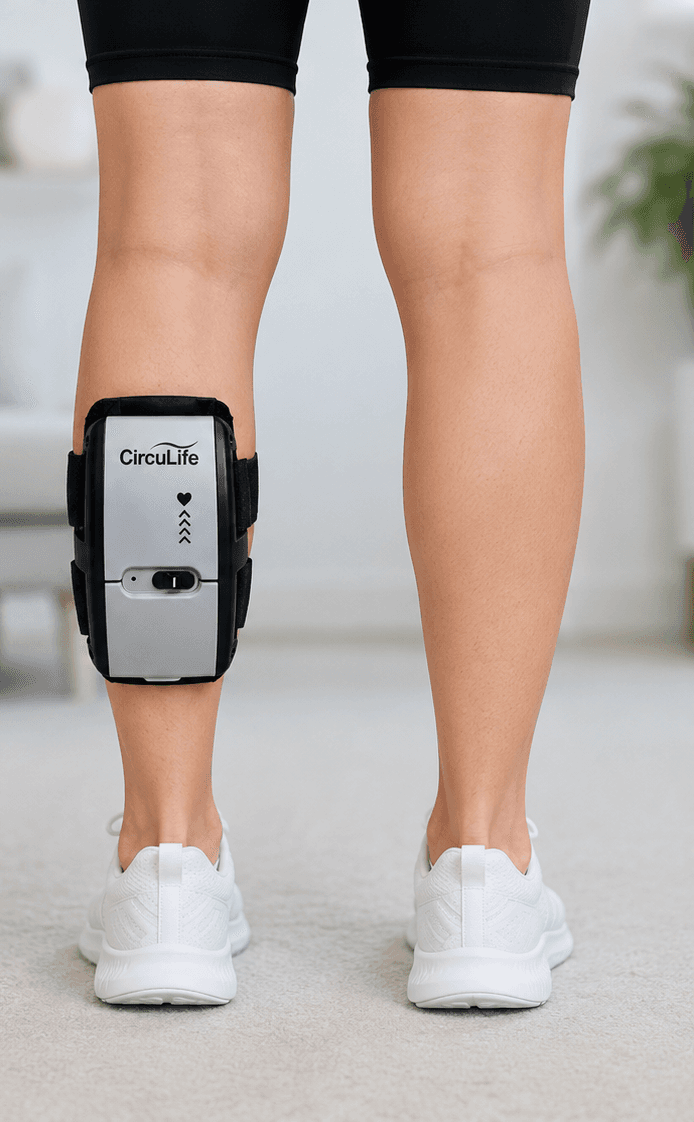
CircuLife brings clinical-grade peristaltic compression out of the clinic and into real life — at home, at work, in transit, on the couch after surgery. A wearable pump on the back of your calf delivers an active wave of pressure that mimics the calf-muscle venous pump, so your circulation keeps moving even when you cannot.
Movement is medicine. CircuLife is a substitute when movement is not possible.
Every step you take pumps blood from your legs back to your heart. When you stop moving — surgery, bedrest, a long flight, a desk-bound week — that pump goes idle. Active compression keeps it running.
The calf-muscle pump
The deep veins of the calf are surrounded by muscle. Every step compresses those veins, pushing blood up against gravity and back to the heart. One-way valves keep it from sliding back down. This is the body’s primary mechanism for venous return below the waist.
What goes wrong
Surgery, bedrest, immobilization, long flights, sedentary work, valve damage from prior DVT, and chronic venous disease all break the pump. Blood pools, pressure rises, fluid leaks into tissue, and pain, swelling, and skin changes follow.
What CircuLife does
A small wearable pump on the back of your calf generates a peristaltic wave of pressure — a moving squeeze rather than a static one. That wave drives venous return and lymphatic drainage in lieu of voluntary motion, exactly when your own pump cannot.
Indications
Who CircuLife is for.
Active peristaltic compression is studied across a range of acute and chronic conditions where the calf-muscle pump is suppressed or insufficient. Use is always under the direction of a qualified clinician.
Post-Operative Recovery
After orthopedic procedures (joint replacement, ACL reconstruction), abdominal, plastic, or vascular surgery, the legs are immobilized at exactly the moment circulation matters most. Active peristaltic compression is studied as a way to reduce post-operative edema and discomfort and to support earlier, safer mobilization. Clinical evidence shows that consistent venous return during recovery is associated with shorter time-to-ambulation and lower limb swelling.
Total knee and hip arthroplasty
ACL and meniscus reconstruction
Abdominoplasty and post-surgical edema
Vascular and bariatric procedures
Post-Thrombotic Syndrome (PTS)
Literature suggests that 25-50% of patients develop PTS after a deep vein thrombosis, depending on the cohort. Symptoms include leg heaviness, chronic swelling, skin changes (hyperpigmentation, lipodermatosclerosis), and in advanced cases, venous ulceration. Active compression is studied as part of conservative PTS management to support venous return and reduce symptom burden.
Persistent leg heaviness or aching after DVT
Chronic edema and skin discoloration
Adjunct to compression stockings
Long-term symptom management
Chronic Venous Insufficiency (CVI)
Chronic venous insufficiency affects an estimated 25 million-plus adults in the United States. Damaged or incompetent valves let blood pool in the lower limbs, raising venous pressure and producing edema, pain, and skin changes. Studies indicate that active compression therapy supports venous return velocity and is associated with reduced edema and discomfort in CVI populations.
CEAP class C2-C5 venous disease
Varicose veins with edema
Venous stasis dermatitis support
Adjunct to ablation or sclerotherapy
Lymphedema
Lymphedema management relies on complete decongestive therapy (CDT) — manual lymphatic drainage, compression bandaging, exercise, and skin care. Pneumatic and peristaltic compression devices are studied as adjuncts within CDT, with the peristaltic wave supporting lymphatic clearance during the maintenance phase of treatment.
Primary and secondary lymphedema
Post-mastectomy lower-extremity involvement
Maintenance phase after CDT
At-home adjunct between therapist visits
DVT Prophylaxis
Mechanical compression is one of the recommended modalities in surgical and immobilized-patient settings — ACCP and CHEST guidelines reference intermittent pneumatic, sequential, and mechanical pumps. Active peristaltic compression is studied where pharmacologic prophylaxis is contraindicated or insufficient and where continuous calf-muscle pump activity is unavailable.
Hospitalized or bedridden patients
Anticoagulant-contraindicated cases
High-risk post-surgical recovery
Combined mechanical-plus-pharmacologic regimens
Travel & Sedentary Risk
Long-haul flights, multi-hour drives, prolonged desk work, and recovery from injury all suppress the calf-muscle pump for extended periods. Clinical evidence shows that mechanical compression during these windows supports venous return and is associated with reduced lower-limb edema and discomfort. Preventive use is studied for travelers with prior venous events or risk factors.
Long-haul flights (>4 hours)
Prolonged desk-bound work
Recovery from immobilizing injury
History of venous events or family risk
Outcomes.
What active compression supports.
Across the literature on peristaltic and mechanical compression therapy, consistent themes emerge. Studies indicate that active wave compression supports the same physiologic outcomes the calf-muscle pump produces during normal walking — improved venous return, lower limb pressures, and reduced edema — without requiring the patient to be on their feet.
The strongest signals appear in adherence. When a therapy is comfortable and easy to use during normal daily activity, patients actually use it. That is where clinical benefit comes from.
Reported in the literature
Reduced lower-limb edema
Improved venous return velocity
Lower self-reported leg pain & heaviness
Improved mobility post-procedure
Adjunct support for venous ulcer healing
Better adherence vs. stockings (per published patient-preference data)
Your experience.
From referral to first session — what to expect.
CircuCore360 handles the operational pieces so you and your clinician can focus on recovery. Here is what each step looks like.
1
Referral
Your clinician identifies CircuLife as appropriate for your condition and sends a referral with the relevant clinical documentation.
2
Onboarding
CircuCore360 reaches out within one business day, verifies your insurance benefits, confirms your shipping address, and ships the device.
3
Fitting & training
A virtual or in-person walkthrough covers proper fit on the back of the calf, controls, daily wear time, charging, and care.
4
Daily therapy
Typically one hour per day per leg, with extended sessions during post-op recovery, travel, or as your provider directs.
5
Follow-up
Automated check-ins, clinical reporting back to your provider, and refill or renewal logistics — all handled by CircuCore.
Important safety information.
Contraindications and safety.
Like every clinical therapy, CircuLife is not appropriate for every patient or every situation. Review the contraindications with your clinician before starting therapy.
Do not use if any of the following apply
Acute DVT in unstable patients without anticoagulation in place
Severe peripheral arterial disease (ABI < 0.5 or as flagged by your provider)
Decompensated congestive heart failure or acute pulmonary edema
Active infection, cellulitis, or skin breakdown over the treatment area
Suspected limb ischemia or critical limb perfusion concerns
Recent skin grafts or fragile post-surgical skin without clinician clearance
Severe peripheral neuropathy without sensation in the treatment area
Any condition for which your treating clinician has not authorized use
Side effect profile and what to watch for
Active peristaltic compression is generally well tolerated. The most common side effects reported are mild skin irritation under the device pod and transient warmth or sensation during the first few sessions as you adapt to the wave pattern.
Stop using CircuLife and contact your provider immediately if you experience new or unusual pain, numbness, tingling, asymmetric or rapidly worsening swelling, skin breakdown, color or temperature changes in the limb, or shortness of breath. These are not expected effects and warrant clinical evaluation.
CircuCore360 coordinates directly with your treating clinician for any safety concern reported during therapy.
In practice.
Designed for the moments recovery actually happens.
The clinic is one hour. Recovery is the other twenty-three. CircuLife is built to fit into the part of the day where life happens.
“Two weeks after surgery I was running CircuLife on the couch while my grandkids ran in circles. The swelling came down overnight and I started physical therapy on schedule.”
Post-op TKA patient, 62
Composite — illustrative
“I am on my feet twelve hours, then I sit on a plane home. I wear it during the flight. My calves do not feel like bricks when I land anymore.”
Long-haul nurse, 41
Composite — illustrative
“Stockings were hard to keep up with. CircuLife is one hour a day on my own time, and the heaviness in my leg is markedly better than it was a year ago.”
PTS patient, 5 years post-DVT
Composite — illustrative
Composite illustrations representing common use cases. Not from individual identifiable patients.
Common questions.
Frequently asked.
If your question is not here, our clinical team is happy to walk you through it.
How long do I wear it each day?
Most patients wear CircuLife for about one hour per day per leg. Post-op, lymphedema, and travel use cases may call for longer sessions. Your treating clinician will set the daily protocol that fits your condition and goals.
Can I walk while wearing it?
CircuLife is designed to be worn during seated or supine activity — at home, at your desk, on a flight, or in bed. Walking is not the intended use mode. Your calf-muscle pump already does the work when you walk; CircuLife is the substitute when you cannot.
Will my insurance cover CircuLife?
CircuCore360 handles benefits verification and billing on your behalf and works with most major commercial payers and Medicare DME coverage where the indication supports it. Coverage depends on your specific plan, diagnosis, and documentation. We confirm your out-of-pocket exposure with you in writing before shipping.
Is CircuLife loud?
No. The peristaltic mechanism is engineered to run quietly — quiet enough to use on a flight, in a shared office, or while sleeping next to a partner. Most patients report it is barely audible at conversational distance.
Can I sleep in CircuLife?
Many patients use CircuLife during evening rest or overnight when their clinician approves it. Comfort and adherence are part of why patient-preference data shows higher uptake than with traditional stockings. Confirm overnight wear with your provider if you have specific cardiac, vascular, or skin concerns.
How is CircuLife different from compression stockings?
Stockings provide static graduated compression — a constant squeeze that depends on the calf-muscle pump being active to move blood. CircuLife generates an active peristaltic wave, so it works while you are seated or lying still. Patient-preference studies suggest active compression has better real-world adherence than stockings.
How is CircuLife different from sequential / IPC pumps?
Sequential and intermittent pneumatic compression (IPC) pumps inflate large bladders that wrap most of the leg — typically used in clinical or hospital settings. CircuLife uses a compact peristaltic wave delivered by a wearable unit on the back of the calf, designed for ambulatory daily use outside the clinic.
What if I have a problem with the device?
CircuCore360 provides device support, troubleshooting, and replacement logistics. If you experience pain, numbness, new swelling, skin changes, or any unusual sensation, stop using the device and contact your provider immediately. Then reach out to CircuCore360 — we coordinate with your clinical team end to end.
Talk to our clinical team.
Whether you are a clinician evaluating CircuLife for a patient or a patient with a referral in hand, we will walk you through indications, fit, daily protocol, and what onboarding looks like.